Toxic Feedback Loops & Public Leadership
📌 The Point:
Between blind defense and overcorrection, there’s a more impactful conversation waiting to happen

Anytime a public leader becomes the center of discourse, the pattern is predictable. The conversation fractures into two familiar camps. On one side, the critique is dismissed outright—people assume that if you take issue with what’s being said, it’s because you don’t understand what it takes to reach that level of success. On the other, the critique sharpens into a moral argument—that the leader in question is being irresponsible, that their narrative lacks context and ignores the realities of access, privilege, and systemic constraint.
Both sides are reacting to something real. But neither is holding the full picture.
In high-visibility moments, participation can easily be mistaken for critical analysis. The algorithm surfaces a topic, thousands of people respond, and the same set of perspectives gets recycled across platforms with slight variations. At a certain point, what feels like meaningful contribution is, in reality, redundancy. It’s low-risk engagement that allows people to feel aligned, informed, or even morally positioned without requiring much introspection or investment.
The harder truth is that not all “accountability” is actually about accountability. Sometimes it’s about correction and the subtle satisfaction of watching someone who has been elevated get pulled back down into reach. That cycle of building people up and then collectively scrutinizing them is deeply embedded in internet culture. It’s not new, but it is accelerating.
In that context, it’s worth acknowledging that audiences can be performative, too. It’s easy to use distance, anonymity, and low stakes to position yourself as more thoughtful, ethical, or aware than the person you’re critiquing, without applying the same level of scrutiny to your own decisions or leadership. That imbalance is rarely addressed, but it shapes the tone of these conversations.
Take the recent discourse around Emma Grede as an example. A common thread in the criticism is that her messaging oversimplifies a complex reality and places too much responsibility on the individual. While that perspective is valid, there’s also a tension embedded within it. By focusing so heavily on what she should be saying—how she should contextualize her ideas and what she’s responsible for including—we end up placing the burden of systemic explanation onto a single individual.
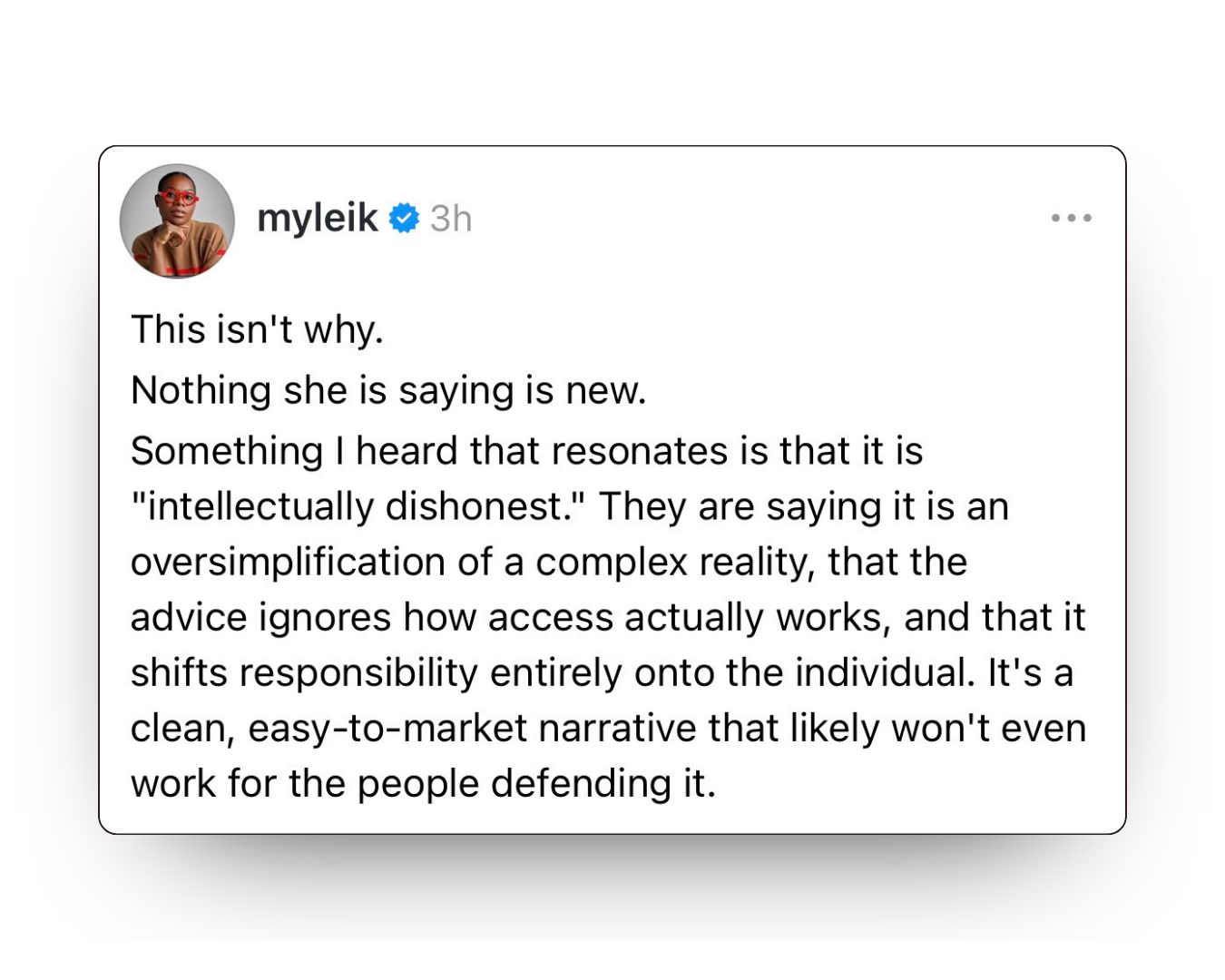
We expect her to hold and communicate nuance at scale, to account for inequality, and educate across lived experiences. And to do all of this while maintaining a narrative that is clear enough to be marketable. While a few rare leaders may meet that expectation, it doesn’t just stretch the role—it misunderstands it.
Public leaders, especially those operating within entrepreneurial or commercial contexts, are not neutral actors. They are participants in systems that reward clarity, aspiration, and conversion. They are building businesses, selling ideas, and shaping narratives that resonate widely enough to sustain attention and revenue. What they produce is not a comprehensive map of reality; it is a point of view designed for distribution.
That distinction matters because it reframes the expectation. It is not the responsibility of an individual capitalist entrepreneur to deliver a perfectly equitable, fully contextualized narrative that accounts for every structural factor influencing outcomes. That is not what the system demands of them, and it is not what the market rewards.
This is where the missing middle comes into focus. If we understand that systems shape outcomes, that narratives are often simplified in order to scale, and that public figures have commercial motivations, then responsibility cannot sit entirely with the speaker. It has to be shared with the audience. Engaging with public content requires a level of media literacy, discernment, and self-awareness that goes beyond passive consumption. It requires the ability to recognize when something is not meant for you, when a framework doesn’t align with your reality, and when a message should be taken as perspective rather than prescription.
Taking a public figure “with a grain of salt” is an acknowledgment of your own role in interpreting what they’re offering.
The issue is that many of these conversations never expand to that level. Instead of moving outward into systemic critique, they collapse inward around the individual. The discourse becomes fixated on what one person said, what they omitted, and how they should correct themselves. In doing so, we remain focused on the most visible and accessible layer of the issue, while the underlying structures that make these narratives profitable and persuasive remain largely unexamined.
There’s also a pattern in who becomes the focal point of these conversations. Women, and particularly women of color, are often subject to a level of scrutiny that is both more intense and more symbolic. Their choices are not just evaluated on their own terms; they are interpreted as indicators of how power should be exercised by people who share their identity. That added layer of expectation creates a different kind of pressure—one that isn’t always applied as consistently to others. Figures like Adam Neumann, former CEO of WeWork, whose leadership narratives have been widely documented and debated, often move through public discourse with a different tone and duration of critique. The disparity doesn’t negate the need for accountability, but it does raise questions about how and where that accountability is concentrated.
None of this is an argument against critique. Critical dialogue is necessary, especially when it comes to people who hold influence and shape public thinking. But there is a point at which critique becomes overinvestment—when the energy directed at analyzing and correcting an individual exceeds the impact that analysis is actually creating.
The more generative question is not simply whether a leader’s message is complete or responsible. It’s how we, as participants in this ecosystem, choose to engage with what we’re consuming. It’s whether we’re willing to examine the systems that reward certain narratives, the incentives that shape what gets amplified, and the role we play in sustaining those dynamics through our attention and participation.
Expanding the frame doesn’t dilute accountability; it deepens it. It shifts the conversation from a reactive cycle of critique toward a more layered understanding of influence, responsibility, and power. And it asks more of all of us—not just the people at the center of the discourse, but the audiences who give that discourse its momentum.
That’s the middle we keep skipping. And it’s where a more honest and impactful critique can begin.

I’m Briaan L. Barron (Bri), a creator based in Seattle, and the CEO of Heye Frequency. My practice bridges branding, public leadership, and cultural strategy. My writing interrogates the future of taste, trust, authority, and community on the Web and in the world.